Illustration Credit & Licence: Wikipedia, Pablo Carlos Budassi
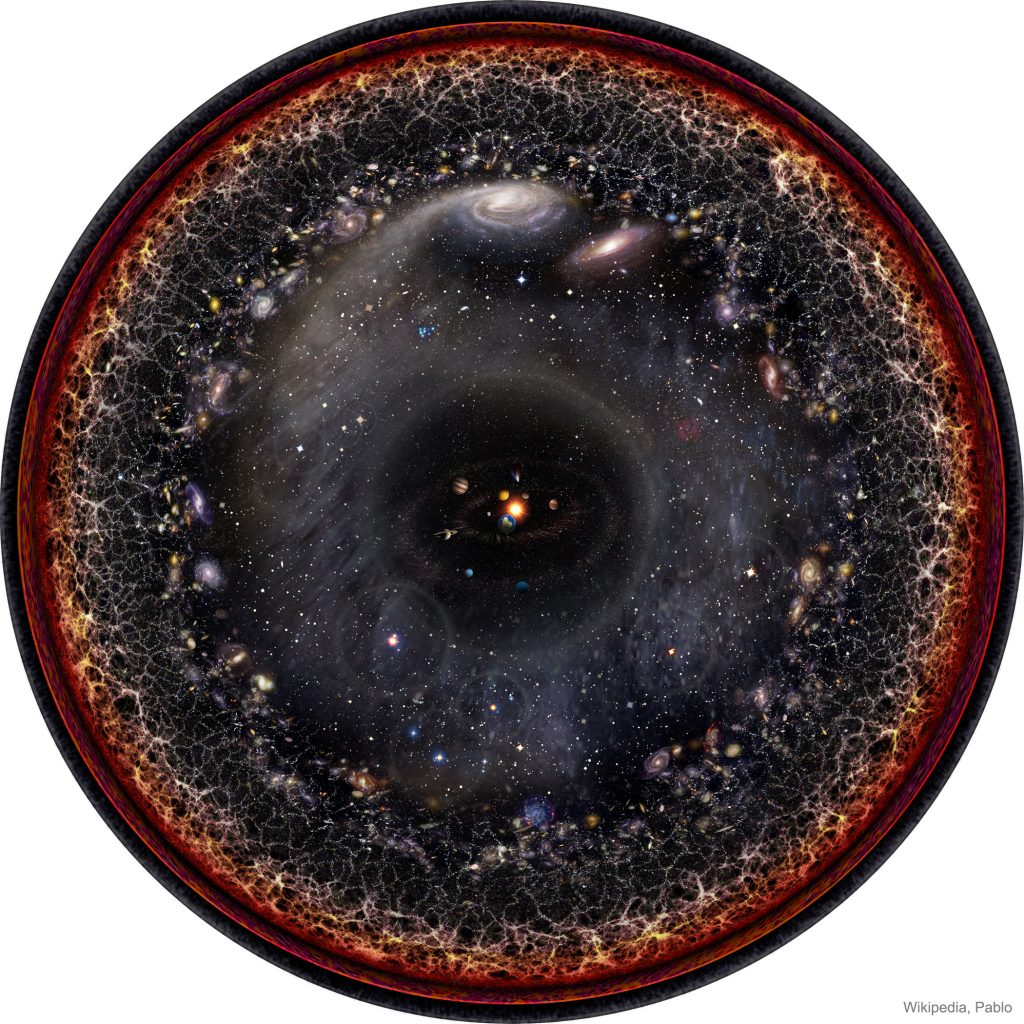
Explanation: How far can you see? Everything you can see, and everything you could possibly see, right now, assuming your eyes could detect all types of radiations around you — is the observable universe. In light, the farthest we can see comes from the cosmic microwave background, a time 13.8 billion years ago when the universe was opaque like thick fog. Some neutrinos and gravitational waves that surround us come from even farther out, but humanity does not yet have the technology to detect them. The featured image illustrates the observable universe on an increasingly compact scale, with the Earth and Sun at the center surrounded by our Solar System, nearby stars, nearby galaxies, distant galaxies, filaments of early matter, and the cosmic microwave background. Cosmologists typically assume that our observable universe is just the nearby part of a greater entity known as “the universe” where the same physics applies. However, there are several lines of popular but speculative reasoning that assert that even our universe is part of a greater multiverse where either different physical constants occur, different physical laws apply, higher dimensions operate, or slightly different-by-chance versions of our standard universe exist.
This photo compilation is from May of 2018 but its still pretty cool to see.

I was speaking with someone today who suggested I may want to re-open the recent post that had a coffee discussion. So I am reopening the original post – anyone can request a re-opening to continue their dialogue – the instructions to do so are on the right hand side panel. You can just call or text me too if easier. Michelle mentioned what vessel you might use?
Please keep in mind, with two posts up, there are two places to comment so make sure you are where you want to be.
Thank you for reading today's post. Have an InterStellar Day! ~PrP