We are experiencing unprecedented times for America. It’s really wild when I think of the changes my generation has lived through.
Jimmy Kimmel being fired is part and parcel of the Orange Clown’s agenda to squash free speech. This is the political polarization orchestrated by the agenda of the THF (the heritage foundation) P25 (project 25) in full bloom.
The OIO (Orange In Office – I’m going to use OIO going forward to protect my free speech on the internet) is shutting down any voice that is contrary to the MAGots’ point of view. The outrage of the right to the dissention of the iconization of Charlie Kirk is almost laughable. It’s horrific to find ourselves here imo. Is free speech dead? Will enough righteous humans stand up to the flagrant abuse of the law and presidential power? THF has embedded itself in all roles of government for years now to implement their agenda. We may be passed the point of no return (upcoming post: shadow dockets of SCOTUS):
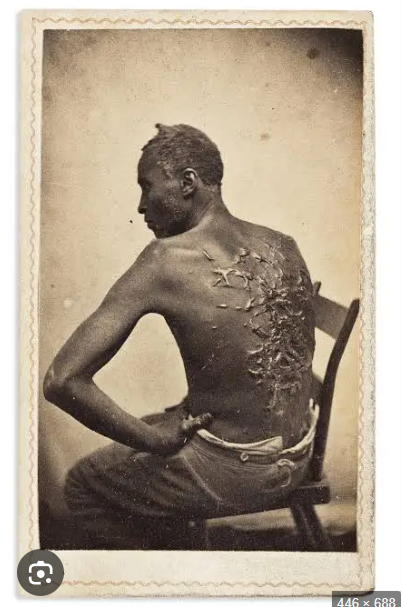
OIO is removing information from museums and history sites to whitewash history, again. This is pure Nazi Germany. My heart breaks for the World, the planet, and those of us with consciousness and empathy. Today’s outrage is over OIO ordering a National Park Service at Fort Pulaski National Monument in Georgia to remove a reproduction photo of “The Scourged Back,” who was freed slave named Peter and sometimes Gordon that exposed the scars on his back from having endured so many whippings a slave.
9/18/25 Wash. Post (Wash., D.C.) B01 2025 WLNR 23841249 Washington Post, The (Washington, D.C.) Copyright (c) 2025 The Washington Post
September 18, 2025 Issue DAILY Section: Style
Stark photo has played critical role
Philip Kennicott
In the two centuries since the medium was invented, few photographs have had a more powerful impact on the American conscience than a series of images made in 1863 of a formerly enslaved man known by at least two names, Gordon and Peter. Early in 1863, he escaped the hell of enslavement and found safety among Union forces in Louisiana, thus becoming contraband, to use the solecism common at the time.
Peter was photographed shirtless, in the presence of a doctor, exposing to the camera and the world a thick web of welts and scars, the living memory of the whip that once scourged his naked back.
The image shocked even those who knew the brutality and horrors of slavery through close observation and passive or active participation in its violence. It quickly circulated, via newspapers and cartes de visite – small, easily reproduced, palm-sized prints on card stock that could be carried, exchanged and sent through the mail. Along with Harriet Beecher Stowe’s 1852 abolitionist novel, “Uncle Tom’s Cabin,” and the first two autobiographies and oratory of Frederick Douglass, the image known as “The Scourged Back” is among the most significant spurs to moral outrage in the history of the United States. In the larger history of photography, it is near the top of any list of the most influential images since Joseph Nicéphore Niépce trained his camera on some nondescript rooftops visible from his window in Burgundy, France, in the mid-1820s.
Citing two sources familiar with the situation at one historical site, The Washington Post reported Monday that the Trump administration will remove a display of the photograph from a Park Service unit that deals with slavery and the Civil War, as part of its campaign against what it deems “corrosive ideology.” (The sources did not identify the park in question for fear of reprisals.) An Interior Department spokeswoman disputed that account Tuesday, saying that parks had received no such order. The New York Times subsequently reported, based on emails and other sources, that the order was issued to staff at the Fort Pulaski National Monument in Georgia, a Confederate fort captured by the Union and later used as a prisoner-of-war camp. A copy of the photo was on view at the fort, and numerous versions of the image by different photography studios are in the collections of this country’s major museums, including the National Gallery of Art, the Metropolitan Museum of Art and the National Portrait Gallery.
“The Washington Post continues to rely on anonymous sources and unverified claims to drive a false narrative,” wrote Elizabeth Peace, senior public affairs specialist at the Office of the Secretary of the Department of the Interior, when asked which parks might be affected and the administration’s rationale for removing the image. “In accordance with Secretary’s Order No. 3431, Restoring Truth and Sanity to American History, all interpretive signage in national parks is under review.”
The confusion, if it’s confusion, is similar to an effort (quickly reversed) to remove a video about the legendary Black pilots unit known as the Tuskegee Airmen from Air Force training curriculums during the first weeks of the administration. Broad executive orders targeting diversity, equity and inclusion initiatives have created enormous anxiety and fear among the trained historians, curators and interpreters at the Smithsonian, the Park Service and other organizations. The pattern, a maximal gesture in the direction of censorship followed by confusion and a range of voluntary efforts at compliance, is familiar enough that it can be read as intentional.
But whoever floated the idea of removing the 1863 image is right: Few photographs are more corrosive. For Americans who may have wavered in their opposition to slavery during some of the darkest days of the Civil War, “The Scourged Back” scoured away complacency, apathy and fatigue. It reminded the world of what it already knew, that the slave regime of the South could be maintained only by paroxysms of violence.
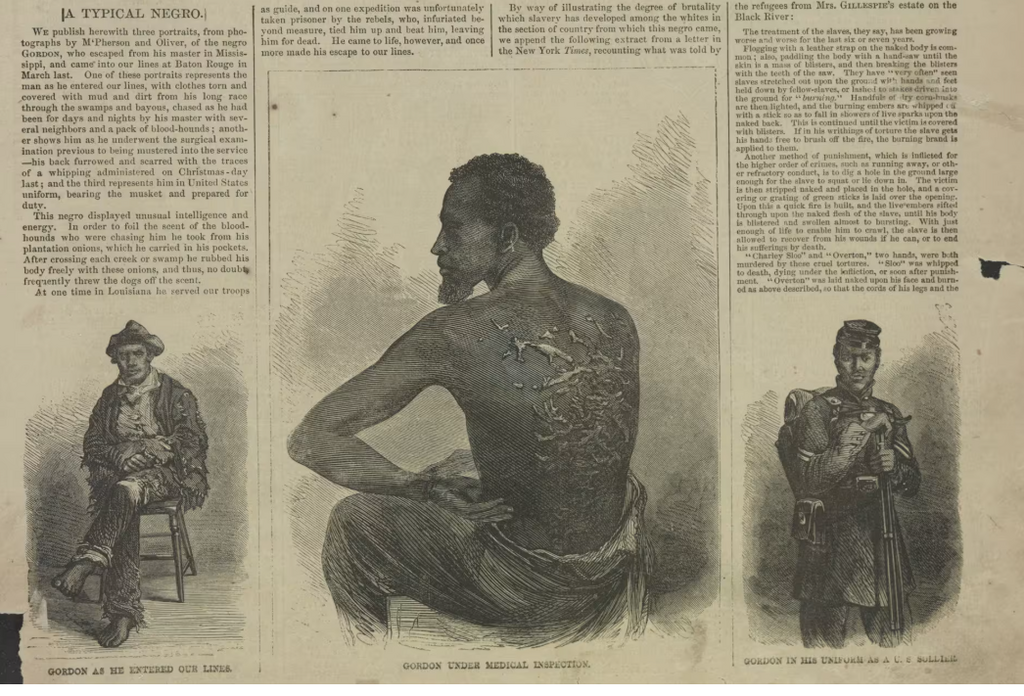
Some icons are beloved; others are held in awe. “The Scourged Back,” in which the man is seen in profile, revealing his wounds as if they belong not to his essential self but to everyone who has violated his dignity, inspires first silence, then a rising nausea and an urgent need to be sure that it is seen, understood, processed. The day after the battle of Gettysburg, the image appeared in Harper’s Weekly, part of a trio of pictures documenting the escape, scars and enlistment in the Union army of the man the publication referred to as Gordon. Several images of the same man were made after his escape, but the one that seems to have circulated most widely is also the most artfully constructed, with Gordon (a.k.a. Peter) seen in full profile and thus with more individuality than some other prints.
The sense of urgency in the image was felt almost from the moment it appeared. An early critic, writing of its potential impact on public feeling, wrote: “This Card Photograph should be multiplied by 100,000, and scattered over the States.” He went on to suggest that it would be superior to Stowe’s novel in its impact on the antislavery sentiment. The photograph also inspired visceral reactions from those who resisted the truth of American slavery. While riding on a train, one passenger saw another looking at the image and asked to purchase it from the man. After taking possession of the photograph, the new owner angrily tore it to shreds, according to an anecdote that appeared in the abolitionist newspaper the Liberator.
That the idea of suppressing such a historically and culturally important image could circulate, even for a moment, within the Park Service is appalling and terrifying. The supposedly neutral content reviews at the Park Service, Smithsonian and other organizations have already targeted basic truths of American history and touchstones of the American conscience.
It is increasingly clear that these initiatives are driven by a bizarre mix of audacity and ignorance. Only the willfully ignorant would target an image as indelible, as fundamental a symbol of ineffaceable truth, as the image of Peter/Gordon’s back. Not only did hundreds of thousands of reproductions of the image circulate in the 19th century, but the image became an essential reference point during the civil rights struggle, and for artists and authors into the current century. When Sethe, the traumatized former enslaved woman who is the central character in Toni Morrison’s 1987 novel “Beloved,” speaks of a “tree on my back,” she is probably referencing the excruciating foliage of wounds in this photo. When Lincoln, in his second inaugural address, said that “every drop of blood drawn with the lash shall be paid by another drawn with the sword,” he may have had this image in mind.
It can’t be extricated from history, so censorship would seem folly. Throughout the history of this image, one basic reading is that scars are a kind of writing that can never be erased.
But the image, which appeared during the Civil War, didn’t just goad the conscience; it also terrified those who looked ahead to a new age, after the war, after liberation. Would the scars of America’s primal crime be permanent? How could people who bore this truth in and on their bodies be incorporated into a newly reconstructed society? What miraculous extremes of forgiveness would be necessary for reconciliation?
Another recurring motif of criticism focuses on the dignity of the man, the violation of his body not just by the lash but the camera, and by generations of White people who needed such raw evidence to understand the truth of slavery. That may be the reason someone chose this image as expendable, as evidence of the supposedly corrosive thinking the administration would banish. When he became a symbol, he also became an object, and objects aren’t people.
The only way to negate the power of this image is to negate the man’s humanity. And why not go big? Swing for the fences when it comes to rewriting history. If you can erase “The Scourged Back,” if you can erase Peter, or Gordon, or any one of the millions of enslaved people who suffered similar torments or worse, then you can erase anything, and nothing will trouble the American conscience ever again.
—————
The Shocking Photo of ‘Whipped Peter’ That Made Slavery’s Brutality Impossible to Deny
Have you noticed that the media is not covering the AMAZING event that happened in Nepal this month? FOUR DAYS for The People to enact change! Way to go!
The recent Nepali movement in September 2025, primarily driven by younger generations, led to the swift resignation of Prime Minister K.P. Sharma Oli. The protests, sparked by a ban on social media and fueled by anger over corruption and economic hardship, began on September 8th. Prime Minister Oli resigned the very next day, September 9th.
However, the President of Nepal, Ram Chandra Poudel, did not resign during this movement. There were initial reports to that effect, but the Nepalese Army later denied them and confirmed that Poudel remained in office. Poudel then dissolved parliament and set a date for new elections after Karki’s appointment.
The protests continued after Oli’s resignation, with demonstrators setting fire to several government buildings and the residences of politicians. Calm was eventually restored on September 13th, after Sushila Karki, a former Supreme Court Chief Justice, was sworn in as the interim Prime Minister on September 12th.
Some of you may be wondering where some of the regulars are. Solar storms have been particularly wicked (knocked out starlink) lately. ABs are closer to the sun than the satellites, so we wish them well, and hope for minimal loss of life.
Thank you for reading today's post.
Have an InterStellar Day! ~PrP
If you couldn’t load the link it is a video of OIO and Stepford Wife standing next to King Charles and Camilla, with a British military procession going by. One rider is on a horse directly passing OIO and the horse takes a crap. One for the animals for sure.
So the Gate has reopened. Thanks for the assistance. Was’t it the actions of the Immortal that forced us out of the Gate? Or rather the non actions. IT refused to block this Sun’s super explosions that directed all that solar energy towards us.
So tell us again why we are supposed to leave IT alone.
They have arrived to discuss terraforming several planets in the 3(kD43 Solar System. We are not opposed to their suggestions, but their expertise has to do more to do with life on this planet. How aliens can adapt to the extreme environments of Earth.
Let’s not be too quick to pass on their advice. They can show us how to live in environments on this planet that the humans could not even survive in. That would lessen the chances of discovery.
Yeah, but their expertise begins at the point on a planet where chemistry becomes biology. That exists somewhere at the bottom of the ocean on this planet. Haven’t most of that science been worked a couple of thousand years ago?
Comments are closed.
Welcome to The Avenue
Please be respectful of your interactions with others here. Threats will not be tolerated.
To Re-Open Comments on a Past Post
This blog is set up for comments allowed only on the latest post. If you wish me to re-open a prior post so you can continue the discussion, use the language below. In this case, we are using the example of a past post that was entitled “The Social Dilemma“:
PrP r/o (and name of post you want reopened)
PrP r/o The Social Dilemma
I would then re-open the post and comments on the post “The Social Dilemma.”






There were several attempts to post this link. Ira and Ari, I see you. Kinda wish I didn’t.
https://vocal.media/criminal/crime-chronicles-the-werewolf-of-wysteria
Lisa (last post yesterday) – that was great.
If you couldn’t load the link it is a video of OIO and Stepford Wife standing next to King Charles and Camilla, with a British military procession going by. One rider is on a horse directly passing OIO and the horse takes a crap. One for the animals for sure.
So the Gate has reopened. Thanks for the assistance. Was’t it the actions of the Immortal that forced us out of the Gate? Or rather the non actions. IT refused to block this Sun’s super explosions that directed all that solar energy towards us.
So tell us again why we are supposed to leave IT alone.
They have arrived to discuss terraforming several planets in the 3(kD43 Solar System. We are not opposed to their suggestions, but their expertise has to do more to do with life on this planet. How aliens can adapt to the extreme environments of Earth.
Let’s not be too quick to pass on their advice. They can show us how to live in environments on this planet that the humans could not even survive in. That would lessen the chances of discovery.
Yeah, but their expertise begins at the point on a planet where chemistry becomes biology. That exists somewhere at the bottom of the ocean on this planet. Haven’t most of that science been worked a couple of thousand years ago?